Disability’s in Eye of Beholder
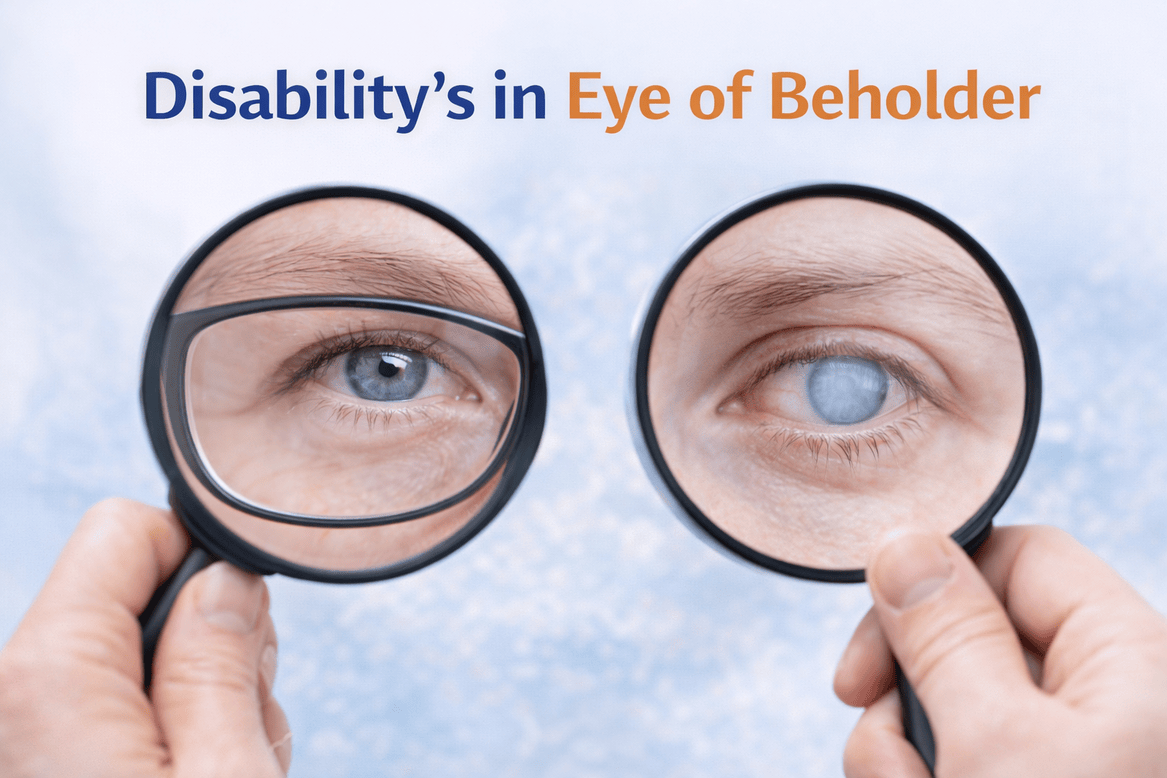
Vision loss is often seen as limitation—but in reality, it is more about perception than possibility.
When people hear the term “visual disability,” they often imagine restriction, dependence, or inability. But step into the life of someone living with low vision or blindness, and you’ll often find something very different—adaptation, resilience, and a redefined way of experiencing the world.
The phrase “disability is in the eye of the beholder” is not just philosophical—it reflects a real shift in how we understand vision impairment today.
Medically, visual disability can arise from various causes—retinal diseases, optic nerve damage, glaucoma, or trauma. In many cases, the loss of vision may be partial, affecting clarity, contrast, or peripheral awareness rather than complete blindness. But what truly shapes a person’s life is not just the diagnosis—it’s how early it is managed and how effectively support systems are put in place.
Because vision loss does not remove ability—it changes how ability is expressed.
One of the most important aspects of modern eye care is not just treatment, but rehabilitation and empowerment. With the right interventions, many individuals with visual impairment continue to lead independent, productive, and fulfilling lives.
What truly helps individuals adapt and thrive with visual challenges:
- Early diagnosis and intervention to slow progression and preserve usable vision
- Low vision aids such as magnifiers, special lenses, and digital assistive devices
- Assistive technology including screen readers, voice-enabled tools, and smart devices
- Vision rehabilitation programs to improve daily functioning and mobility
- Emotional and social support to build confidence and independence
These are not just tools—they are enablers of independence.
There is also a critical social dimension to visual disability. Often, the biggest barriers are not physical but perceptual. Misunderstandings, lack of awareness, and societal assumptions can limit opportunities more than the condition itself. When environments become inclusive—through accessible design, supportive workplaces, and informed communities—individuals with visual impairment can perform at par with anyone else.
From a clinical perspective, the role of an eye specialist goes beyond diagnosis and treatment. It involves guiding patients through the journey—helping them understand their condition, introducing them to available solutions, and supporting them in adapting to changes without losing confidence.
Importantly, not all vision loss is irreversible. Many conditions, if detected early, can be treated or controlled effectively. Even in cases where full restoration is not possible, preserving functional vision can make a significant difference in quality of life.
The conversation, therefore, needs to shift—from what is lost to what is still possible.
Because the human brain is remarkably adaptable. With time and support, individuals learn to rely on other senses, develop new skills, and navigate the world in ways that may seem extraordinary to others—but become natural to them.
Vision, after all, is not just about sight. It’s about perception, awareness, and connection with the world.
And when we begin to see beyond the limitation, we realize that disability is not defined by the eye—but by how we choose to understand it.
Quick Enquiry
Vision Care
- 10 Effective Ways to Protect Your Eyes from Sun Damage
- 5 Symptoms of Sun-Induced Eye Conditions That Require Medical Attention
- Beyond Sunglasses: Alternative Methods to Shield Your Eyes from the Sun
- Exploring the Advantages of Glaucoma Treatment in Dubai
- Exploring the Root Causes of Glaucoma
- How Intravitreal Injections Help Manage Diabetic Retinopathy
- How Intravitreal Injections Help Manage Diabetic Retinopathy
- How to Choose the Right Sunglasses for Maximum Eye Protection
- How to Choose UV-Protective Contact Lenses for Sun Safety
- How to Protect Your Eyes from the Sun While Driving
- How Your Heart Affects Your Eyes: The Hidden Connection
- Questions to Ask Your Ophthalmologist About Diabetic Retinopathy
- Recovery and Healing: What to Expect After Microincision Cataract Surgery
- Red Eyes After Sun Exposure: Should You Visit an Eye Specialist?
Author
Dr. Vasu Kumar
Vitreoretinal Surgeon | Head of Ophthalmology, NMC Royal Hospital FACS | FICO | FAICO
With expertise in vitreoretinal surgery and advanced eye care, he combines clinical experience with a patient-focused approach to managing complex retinal conditions. His work is centered on protecting vision, delivering precise treatment, and helping patients achieve better long-term eye health.