Children’s Vision and Eye Care Basics
A child rarely complains about poor vision—not because everything is fine, but because they don’t know what “clear vision” is supposed to feel like.
Instead, they adapt.
They sit closer to the TV. They hold books unusually near. They lose interest in reading or struggle to concentrate in school. What often appears as distraction or lack of interest may actually be a vision problem quietly affecting their learning and development.
Vision plays a foundational role in a child’s early years. Nearly 80% of learning is visual, yet many eye conditions in children go undetected simply because there are no obvious complaints. Unlike adults, children assume that what they see is normal, even if it’s not.
This makes early eye care not just important—but essential.
The development of vision begins from infancy and continues through early childhood. During this period, the brain learns how to process visual information from both eyes. If something interferes with this process—such as blurred vision, eye misalignment, or unequal focus—the brain may start favoring one eye over the other, leading to long-term complications if not addressed early.
And here’s the key point: most childhood vision problems are highly treatable—but only if detected in time.
So instead of waiting for symptoms, parents need to shift toward proactive screening.
What parents should actively monitor and implement:
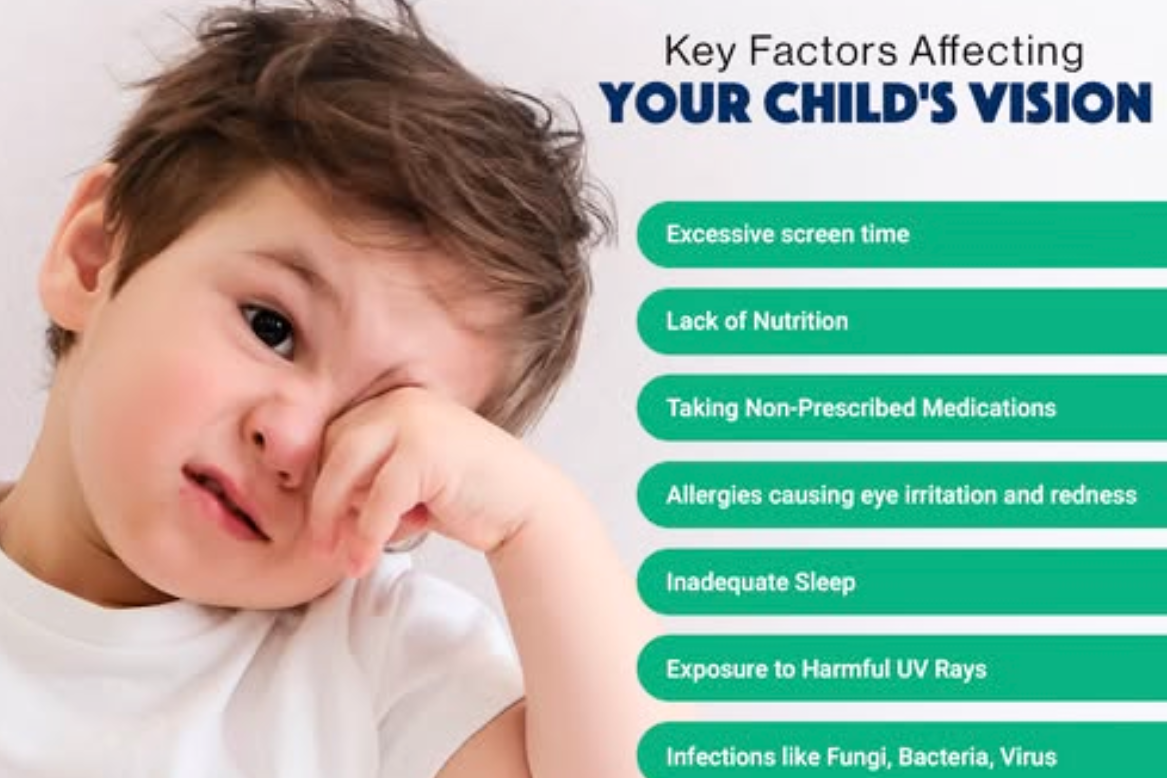
- Early vision screening (before age 5) to detect refractive errors or developmental issues
- Watch for behavioral signs like squinting, eye rubbing, head tilting, or lack of focus
- Limit excessive screen time to reduce digital eye strain and early myopia risk
- Encourage outdoor activities, which support natural visual development
- Ensure a balanced diet rich in Vitamin A, lutein, and omega-3 for eye health
These steps may seem simple, but they play a powerful role in shaping a child’s visual future.
Another growing concern today is digital exposure. With screens becoming a part of daily learning and entertainment, children are spending more time focusing on near objects. This prolonged near work can lead to eye strain, dryness, and an increasing incidence of early-onset myopia (short-sightedness).
Simple habits, like the 20-20-20 rule—every 20 minutes, looking 20 feet away for 20 seconds—can help reduce strain. But more importantly, creating a balanced routine between screen time and outdoor play is crucial.
Parents should also understand that not all vision issues are obvious. Conditions like amblyopia (lazy eye) or binocular vision problems may not show clear external signs but can significantly affect depth perception and learning ability. This is why relying only on school screenings is not enough—comprehensive eye exams provide a deeper and more accurate evaluation.
The encouraging part is that when detected early, most pediatric eye conditions can be managed effectively with simple interventions like glasses, eye exercises, or minor treatments. However, delays can lead to permanent vision impairment that cannot be fully corrected later in life.
Eye care, therefore, should be seen as part of a child’s overall development plan—not a reactive step taken only when problems arise.
Because clear vision doesn’t just help a child see better—it helps them learn better, grow confidently, and engage fully with the world around them.
And sometimes, all it takes is one timely eye check-up to change that entire journey.
Quick Enquiry
Vision Care
- 10 Effective Ways to Protect Your Eyes from Sun Damage
- 5 Symptoms of Sun-Induced Eye Conditions That Require Medical Attention
- Beyond Sunglasses: Alternative Methods to Shield Your Eyes from the Sun
- Exploring the Advantages of Glaucoma Treatment in Dubai
- Exploring the Root Causes of Glaucoma
- How Intravitreal Injections Help Manage Diabetic Retinopathy
- How Intravitreal Injections Help Manage Diabetic Retinopathy
- How to Choose the Right Sunglasses for Maximum Eye Protection
- How to Choose UV-Protective Contact Lenses for Sun Safety
- How to Protect Your Eyes from the Sun While Driving
- How Your Heart Affects Your Eyes: The Hidden Connection
- Questions to Ask Your Ophthalmologist About Diabetic Retinopathy
- Recovery and Healing: What to Expect After Microincision Cataract Surgery
- Red Eyes After Sun Exposure: Should You Visit an Eye Specialist?
Author
Dr. Vasu Kumar
Vitreoretinal Surgeon | Head of Ophthalmology, NMC Royal Hospital FACS | FICO | FAICO
With expertise in vitreoretinal surgery and advanced eye care, he combines clinical experience with a patient-focused approach to managing complex retinal conditions. His work is centered on protecting vision, delivering precise treatment, and helping patients achieve better long-term eye health.