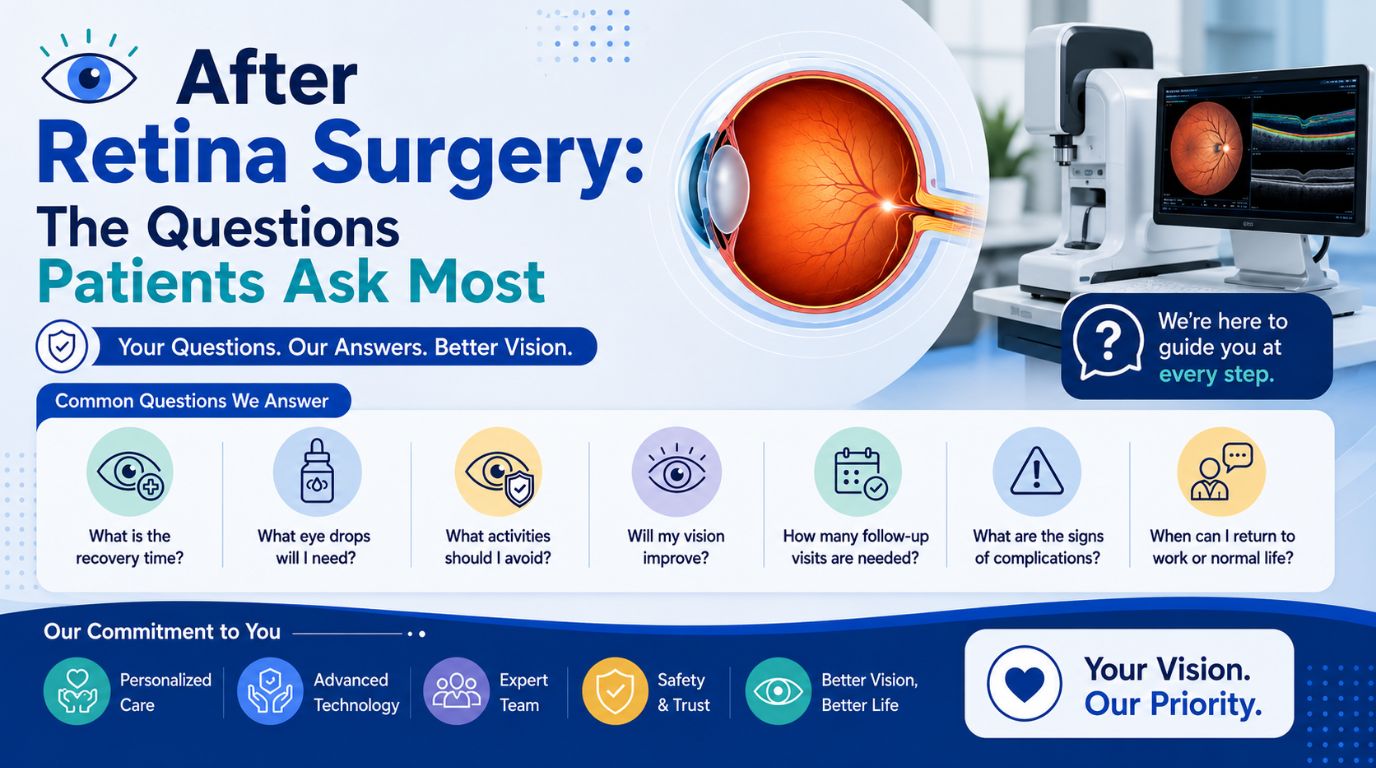
After Retina Surgery: The Questions Patients Ask Most
The surgery is over. The patient is back in the room, the eye has been treated, and the operating theatre is now behind them.
For the surgical team, an important part of the procedure has been completed.
For the patient, however, a new part of the journey has just started.
They look around, try to understand how the eye feels, perhaps attempt to check their vision—and then come the questions.
💬 PATIENT QUESTION
“Doctor, when will I be able to see clearly?”
Then another.
💬 PATIENT QUESTION
“Can I sleep normally tonight?”
And once the patient starts thinking about going home:
💬 PATIENT QUESTION
“When can I get back to my normal routine?”
These may sound like simple questions, but they are an important part of recovery after retina surgery.
Surgery happens in the OT. Recovery happens in everyday life.
“Doctor, Why Is My Vision Still Blurry?”
This is often one of the first concerns after retina surgery.
A patient may naturally think that once the retinal problem has been treated, vision should immediately become clear.
But retinal recovery does not always work that way.
💬 PATIENT QUESTION
“The surgery is done. Why can’t I see properly yet?”
The eye needs time to heal. The original retinal condition, the area affected, the complexity of surgery, and the procedure performed can all influence visual recovery.
If a gas bubble or silicone oil has been used during surgery, the patient’s vision may also be different during the recovery period.
This is why visual recovery is discussed individually rather than giving every patient the same timeline.
Sometimes the most useful answer is not a date.
It is seeing how the eye is healing at the next examination.
“Can I Sleep Normally?”
After leaving the OT, something as ordinary as going to sleep can suddenly become a concern.
💬 PATIENT QUESTION
“Which side should I sleep on tonight?”
In some retinal procedures, particularly when a gas bubble is used, specific head positioning may be recommended. The required position and duration depend on the retinal condition and the procedure performed.
For a patient, this can mean changing normal sleeping habits temporarily.
🩺 AFTER SURGERY
Positioning instructions are specific to the individual operation. Patients should follow the instructions provided by their retina surgeon rather than copying another patient’s positioning routine or relying on general advice online.
What was appropriate for a friend who had retina surgery may not be appropriate for another eye.
“When Can I Go Back to Work?”
Once the first concern about surgery begins to settle, attention often returns to normal life.
Work. Driving. Exercise. Screens. Showering. Bending down. Household activities.
Patients want to know when life can feel normal again.
💬 PATIENT QUESTION
“Doctor, can I go back to work next week?”
The answer depends partly on the type of work.
A patient working at a desk may have different considerations from someone whose job involves lifting, strenuous physical activity, dust, or other occupational demands.
The surgery itself also matters.
Instead of treating recovery as a fixed timetable, activity recommendations can be adjusted according to the procedure and how the eye is healing.
“Can I Fly After Retina Surgery?”
This question can become particularly important in Dubai, where many patients travel frequently for work or to visit family.
A flight booked months earlier may suddenly become part of the medical conversation.
💬 PATIENT QUESTION
“I have a flight next week. Can I still travel?”
If a gas bubble is present inside the eye, air travel can be unsafe. Reduced atmospheric pressure at altitude can cause the gas to expand, which may significantly increase pressure inside the eye.
⚠️ IMPORTANT AFTER SURGERY
If gas has been placed inside your eye, do not fly until your treating surgeon confirms that the gas has resolved and air travel is safe.
Patients planning to travel should discuss those plans with their surgeon after the procedure rather than assuming they can fly because the eye feels comfortable.
“What If Something Doesn’t Feel Right?”
Once patients return home, they no longer have the surgical team immediately beside them.
That is often when small worries become bigger.
“Is this normal?”
“Should I wait?”
“Should I call?”
Good postoperative communication should help answer those questions before they become stressful.
💬 PATIENT QUESTION
“How do I know if something is wrong?”
Some changes may be expected during recovery, depending on the procedure. However, a sudden or significant deterioration in vision, severe or increasing pain, marked redness, or other warning symptoms identified by the treating surgeon should be reported promptly.
Patients should leave after surgery knowing what is expected, what precautions to follow, and when they should contact their retinal team.
Follow-Up: Where Many Questions Get Answered
The conversation does not stop once the patient leaves the hospital or clinic.
At the next follow-up, the patient may arrive with a completely different set of questions.
💬 “Is my retina healing well?”
💬 “Can I sleep normally now?”
💬 “Can I start exercising?”
💬 “When can I drive again?”
💬 “When do you want to see me next?”
These questions may feel less dramatic than the decision to have surgery, but they matter enormously to the person recovering.
During postoperative visits, the retina can be examined, healing assessed, and recommendations adjusted according to the patient’s progress.
This is also an opportunity to discuss anything the patient has noticed at home rather than waiting and wondering whether it is normal.
The Conversation Should Continue After the OT
A retina surgeon’s role does not simply end when the instruments are put down.
There is the conversation before surgery, when the patient needs to understand what is happening.
There is the work inside the operating theatre, where the focus is on the eye.
And then there is the conversation afterward, when the patient needs to understand recovery.
At Retina Care Dubai, postoperative follow-up with Dr. Vasu Kumar forms part of the retinal surgery journey, with advice based on the procedure performed, retinal findings, and how the individual eye is healing.
Because for patients, recovery is not measured only by what happened in the OT.
It is measured in everyday moments—sleeping comfortably, returning to work, travelling again, getting back to familiar routines, and knowing what to do when something does not feel right.
🩺 REMEMBER
If you have recently undergone retina surgery and are concerned about a change in your eye or vision, contact your treating retinal team rather than waiting for the next routine appointment.
The surgery may be over.
The conversation—and the care—continues.
Quick Enquiry
Vision Care
- 10 Effective Ways to Protect Your Eyes from Sun Damage
- 5 Symptoms of Sun-Induced Eye Conditions That Require Medical Attention
- Beyond Sunglasses: Alternative Methods to Shield Your Eyes from the Sun
- Exploring the Advantages of Glaucoma Treatment in Dubai
- Exploring the Root Causes of Glaucoma
- How Intravitreal Injections Help Manage Diabetic Retinopathy
- How Intravitreal Injections Help Manage Diabetic Retinopathy
- How to Choose the Right Sunglasses for Maximum Eye Protection
- How to Choose UV-Protective Contact Lenses for Sun Safety
- How to Protect Your Eyes from the Sun While Driving
- How Your Heart Affects Your Eyes: The Hidden Connection
- Questions to Ask Your Ophthalmologist About Diabetic Retinopathy
- Recovery and Healing: What to Expect After Microincision Cataract Surgery
- Red Eyes After Sun Exposure: Should You Visit an Eye Specialist?
Author
Dr. Vasu Kumar
Vitreoretinal Surgeon | Head of Ophthalmology, NMC Royal Hospital FACS | FICO | FAICO
With expertise in vitreoretinal surgery and advanced eye care, he combines clinical experience with a patient-focused approach to managing complex retinal conditions. His work is centered on protecting vision, delivering precise treatment, and helping patients achieve better long-term eye health.